Chorman Spraying LLC has served farmers, state for three generations
By Carol Kinsley
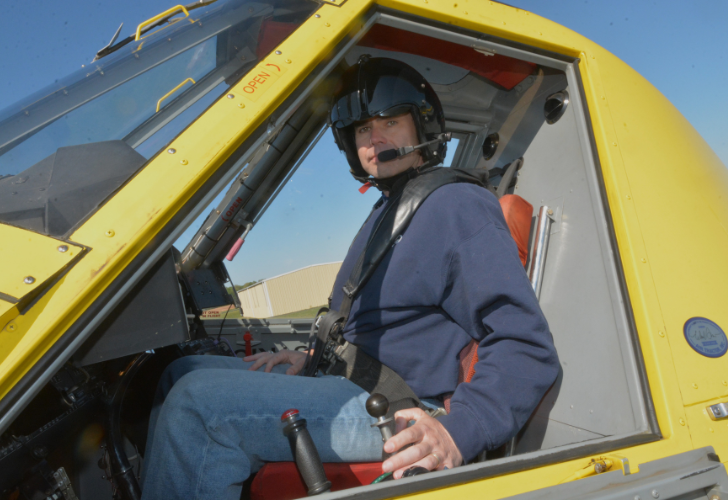
Those small yellow planes buzzing low across Delmarva’s farmland are more than just eye-catching aircraft — they are part of the decades-long agricultural legacy of Chorman Spraying LLC. At the center of this legacy is a third-generation aerial application company serving both farmers and state agencies throughout the Delmarva Peninsula.
Their fixed-wing and rotary-wing aircraft are equipped with sophisticated spray technology, including flow control to provide precise application. Chorman’s aerial services include crop and mosquito spraying, fertilizer application, cover crop seeding, forestry services, marsh application, aerial observation, surveys and on-demand FAA Part 135 charter service for private individuals, companies or state and local governmental agencies.
Specifically, the company’s two Bell Jet Ranger helicopters can carry up to four passengers and a small amount of baggage. For Maryland and Delaware, there are flights to take biologists to count the species and number of waterfowl along migration routes. Newly added services include drone application, “gender reveal” flights and other non-application services.
Today, the company operates a fleet of 24 airplanes and two helicopters across Delaware and Maryland, supported by 25 employees including pilots, mechanics, ground crew and office staff. They utilize five main and 10 satellite airfields across the Peninsula with their main airport located in Greenwood. Other Delaware locations are in Milton, Laurel, Felton and Leipsic. Maryland airfields are in Snow Hill, Hurlock, Ruthsburg, Chestertown and Sudlersville.
“Everything is by GPS,” explained Jeff Chorman, who has managed operations since 2011. “Every field has a prescription, like a doctor would prescribe. They all get different treatments. It’s not blanket coverage; it’s integrated pest management.”
That precision matters. Sweet corn fields, for example, often require repeated insecticide applications to stop pests before they enter the ears of corn. Fungicides help protect corn, soybeans, wheat, barley and lima beans, while aerial seeding of cover crops helps reduce nutrient runoff into waterways like the Chesapeake and Delaware Bay. Cover crops include wheat, barley, radishes of all kinds, clover mixes, rye and clover, rape seed and mustard.
Today, sweet corn is the main crop for which insecticide is repeatedly required. Fields are sprayed five or six times. “Once a worm is in the ear, you can’t kill it,” Chorman said. “You have to prevent it from getting in.”
But behind their precision technology is a deeply personal story rooted in aviation history.
The company’s origins trace back to 1946 when Donald Clark founded Clark’s Spraying Service after returning from World War II. The company was later sold in 1950 to 20-year-old Joe Hudson, who flew from Rehoboth Airport and eventually his own airport, Eagle Crest, north of Lewes in Delaware. Hudson renamed the company Joseph R. Hudson Aerial Spraying and expanded services to include mosquito spraying for the state.
Enter David Chorman, who went to work for Hudson in the 1950s to help maintain the Stearman planes, taking his son, Allen, along. By the age of 10, Allen had his first job working for Hudson for 50 cents an hour, picking up sticks at what is now Eagle Crest Airport in Milton. This led to his own deep love for aviation. After graduating from high school in 1965, Allen began flying and spraying full-time for Hudson. He became his protégé and life-long friend, serving as Hudson’s chief pilot for 20 years.
In 1987, Allen purchased the company from Hudson, relocated its operations to Greenwood, and renamed the company to Allen Chorman, Inc. This name would later change to Allen Chorman & Son, Inc.
Allen had over a 40-year career as an agricultural pilot, logging more than 30,000 accident-free flight hours, and making 13 successful emergency landings after complete engine failures without ever scratching a single aircraft. Allen was deeply respected not only as a pilot, but also by the farmers he worked for who trusted him and relied on his commitment to their livelihoods. It was never “just business” for Allen. He put everything he had into every field he sprayed.
Not surprisingly, Jeff also began flying when he was very young. He made his first solo flight on his 16th birthday in 1995. After graduating from Embry-Riddle Aeronautical University in 2000, Jeff began flying full-time for the company and helped expand operations beyond the Delmarva Peninsula into New Jersey and Pennsylvania. Jeff recently located and purchased the aircraft his dad soloed in at Laurel Airport in 1963, a Cessna 150, and is currently restoring it.
Following in the footsteps of previous generations, Jeff’s oldest daughter, Lucy, recently earned her pilot’s license and is starting her instrument rating. Her boyfriend, Peyton McNamara, works for Chorman and is spraying for the first time this year. He is working on his commercial pilot’s license.
For years, the Chormans have supported NAAA and the industry by hosting numerous EPA field days and demonstrations at their operation, providing equipment for Ag on the Mall and providing an aircraft for the industry’s 100th anniversary celebration in 2021. They have served the local community by participating in parades with one of Allen’s collections of antique tractors, and in offering aerial support in locations farther away, such as the Hurricane Helene Relief Effort in Asheville, N.C., in 2024.
This past February, Allen passed away. He will be remembered as a master pilot, a tireless worker, a devoted husband, father and grandfather, and a man whose perseverance shaped everything he touched. His legacy lives on in the fields he flew, the farmers he served, the people he mentored and the family he loved.
For those interested in scheduling an application for your farm or inquiring about a charter flight, call 302-349-5055.