City of Seaford opens 1976 time capsule during ceremony
By Lynn Schofer
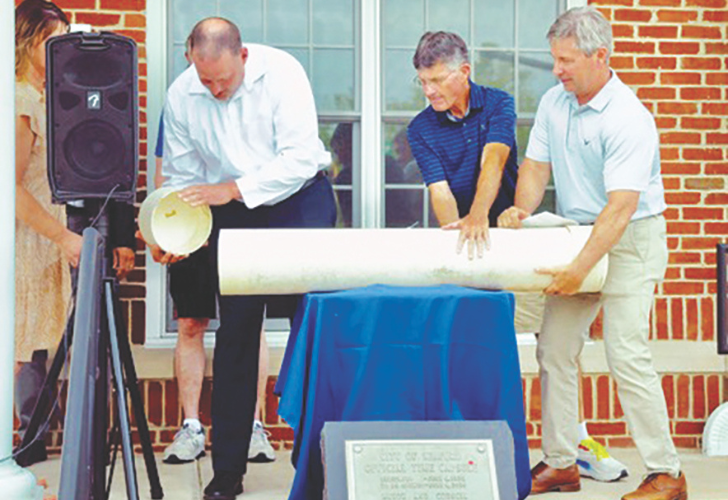
A gathering of the community at the front steps of Seaford City Hall last Tuesday witnessed the opening of the 1976 time capsule. The capsule was buried on King Street on July 4, 1976, and later moved when the new city building was completed.
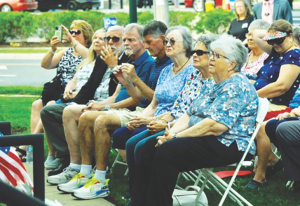
Shown in the audience during the Seaford time capsule ceremony are former City Manager Dolores Slatcher and former council members Grace Peterson and Leanne Phillips Lowe, along with current council members Alan Quillen, Mike Bradley, and Dan Henderson, along with Karen Henderson and Laurie Anderson. Photo by Lynn Schofer
A plaque recognized the 1976 Mayor William Slatcher, council members Marshall Nesbitt, Henry Nutter, Charles Butler, Bill Cash, George Higgins, and City Manager Woody Crosby.
The current council members who were able to attend included Vice-Mayor Dan Henderson, Mike Bradley, and Alan Quillen. Local dignitaries included Senator Bryant Richardson, Representative Danny Short, Seaford Historical Society President Virginia Hastings, Historian Jim Bowden, former city manager Dolores Slatcher, and former council members Grace Peterson and Leanne Phillips Lowe.
Mayor Matt MacCoy welcomed everyone and thanked both Charles Anderson, city manager and Trisha Newcomer, director of Economic Development for their hard work to organize the event. Mayor MacCoy said, “Tonight is 50 years in the making. I have no idea what is in the time capsule. I don’t think anybody in the audience does, so I’m very excited.”
Bowden shared his reflections, “It’s ironic that we’re here in the center of “old” Seaford. If you look from North Street, Water Street on down to Pine Street, this is old Seaford. This is where Seaford’s story started many, many years ago. So, I think it’s prophetic that we’re actually here today doing the time capsule from 1976.” Bowden said the city paid $59.50 for the 1976 time capsule. In 1976 people of Seaford got together for the Bicentennial. They sealed a time capsule, not for themselves, but for all of us. They believed that one day, 50 years in the future, we would all be gathered here and to stand and understand what they stood for, what they were curious about, what the life was like in 1976,” Bowden said. “1976 was a good time in Seaford. Seaford was still proudly known as the nylon capital of the world, it was thriving. Mayor Slatcher helped lead a community with optimism.”
Bowden said his research revealed that former Mayor Slatcher wrote a letter to the 2026 mayor that was placed into the capsule. Bowden said, “It’s not impossible to think about the people that went before us, the people that were here 50 years ago that didn’t make it 50 years later. The items they placed inside the time capsule weren’t just objects, they were pieces of their lives. They were telling us this is who we are, this is what life in Seaford meant to us. As each item is revealed, we’re opening more than a time capsule, we’re opening a window into the lives of people who came before us, allowing us to share, if only for a few fleeting moments in their everyday lives, their hopes and their dreams, we want to say, thank you. Your gift has traveled through time to reach us, and tonight we honor your lives, your community, and your faith in the future. Now, let’s open the time capsule together and make a wonderful journey back to July of 1976.”
Anderson and Mayor MacCoy pulled open the capsule to reveal the many documents that were buried for the last 50 years.
Mayor MacCoy displayed each item as it was retrieved, starting with the Seaford city budget for the fiscal year ending June 30, 1977. “I’m sure it’s exactly the same as it is today,” MacCoy joked. The capsule contained a massive collection of local history from 1976. This included a city flag, a 1976 city code book, an official charter, a local telephone directory, lower Delaware yellow pages, two city maps, official Delaware highway maps, and a 1976 calendar. Media and commemorative items included a bicentennial edition of The Leader, a Delaware State News issue from July 2, 1976, The National Grange Bicentennial Year Cookbook, a Sears Roebuck Catalog, The Sussex Guide, “Mayors of America’s Principal Cities” documentation, and a Seaford Centennial Historical Booklet. The capsule also preserved records from local organizations and events. It held a meeting minutes book from the Seaford Bicentennial Committee (1974–1976), a Seaford Bicentennial Parade permit, a July 4, 1976 church ceremony pamphlet from the Seaford High School Auditorium, a June 4, 1976 bicentennial music program from Central Elementary School, and a poster from the Nylon Capital Shopping Center Merchants Association. Photographs and official markers included a picture of the 1976 mayor and council, a photo of the fire hall, 1976 fire department patches, a roster of all Seaford students from 1975 to 1976, a membership list of the Mary Vining Chapter (1974–1977), and an official plaque designating Seaford as the “Nylon Capital of the World, established in 1865.”
Educational and personal history was also uncovered. The Seaford School District enclosed a special message, alongside information from Frederick Douglass Intermediate School on Swain Road regarding their own time capsule. Buried at their flagpole on June 9, 1976, the school’s capsule contains the names of all building personnel and a message to the students of the year 2076. Personal items in the city capsule included a business message from Gary L. and Diane T. Nichols of Nanticoke Real Estate, and a personal note from James Kelly to his family. One unexpected find directly shocked a current council member. Mike Bradley discovered an item addressed to his brother. “I just got my mind blown away,” Bradley said. “This is to Richard F. Bradley, my brother, from his father-in-law. This is going to be really interesting to find out what the message is.”
The capsule also contained documentation of a community re-signing of the Declaration of Independence, which took place at 8:30 p.m. on July 4, 1976, where participants wore attire representing their favorite patriots. Along with this were copies of a bicentennial pledge. Mayor MacCoy read the pledge aloud: “We, the Americans of 1976, do hereby affirm our support and dedication to the principles which guided the founders of this nation 200 years ago: that all men are created equal, that they are endowed by their Creator with certain unalienable rights, that among these are life, liberty, and the pursuit of happiness.”
Finally, Mayor MacCoy reached the correspondence addressed to his office. “I’m looking forward to reading this,” MacCoy said. “This is 50 years in the making. Our community loves our community, and I really appreciate you guys being out here supporting this city, what it was before and what it is now. Thank you so much.” MacCoy then read aloud the letter from former Mayor Slatcher, followed by a letter from Woodrow Crosby, who served as city manager from 1952 through 1976. Crosby’s letter requested that the items he personally placed inside the capsule be given to his family. If no family members were available, the historical society would claim them after one year. There were business cards, coins, a paperweight, pamphlets, the 1976 plumbing code, and a poem by Pine Street resident Mabel E. Macklin.
The community was invited into the city hall to look over the display of contents and enjoy a social hour.
Mayor MacCoy announced that a new time capsule will be buried and plans for the contents are underway.