
Governor Meyer visits mini-farm, teen center at Western Sussex Boys and Girls Club in Seaford
By Carol Kinsley
Delaware Gov. Matt Meyer visited the Western Sussex Boys & Girls Club in Seaford on Sept. 17, in part to see the mini-farm behind the building and to learn about a new teen center for which construction will soon begin.
Tony Windsor, statewide food program director for the Boys & Girls Club, outlined a brief history of the mini-farm for the governor.
The idea sprouted from a youth garden club started years ago by the Spade & Trowel Garden Club, which built five small raised beds where boys and girls could learn hands-on about growing plants.
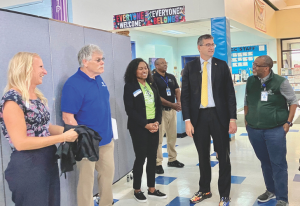
Gov. Matt Meyer was indoors for the start of his visit to see the mini-farm at the Western Sussex Boys & Girls Club in Seaford last week because of rain. Among others meeting with him, from left, were Aimee Beam, of the Department of Education’s Child Nutrition Programs; Tony Windsor, the club’s statewide food program director; Nikko Brady, deputy chief of staff for climate, food systems and planning; Jeremy Duncan, WSB&GC executive director; and, to the right of the governor, Jon Tucker, chief operating officer of the Boys & Girls Club.
In 2019, Windsor, who is also manager of grants development, successfully applied for a $46,000 USDA Specialty Crops Grant through the Delaware Department of Agriculture to fund a teaching garden which has grown to the mini-farm. The plan was to grow fresh produce for the club and the community while teaching the children and adults about horticulture and good nutrition.
Unfortunately, the COVID pandemic delayed the start of the garden until the end of 2021, when Christine Justice of Seaford was hired as agriculture director. With 14 years experience in horticulture, Justice enthusiastically jumped into the project, developing 55 raised beds on the allotted one-third acre where she grew 30 varieties of vegetables, 25 varieties of herbs and 14 kinds of fruit, peanuts and flowers for pollinators. That first year, the farm produced 3,000 pounds of food.
A refrigerator was placed inside the entrance to the club where the community could help themselves to the bounty. During the summer, produce was available at soccer games and swim meets, enhancing community contact. Some of the produce was prepared in the club kitchen to include in the children’s meals.
“This club is key to the ‘farm to kitchen’ program,” said Jon Tucker, chief operating officer of Boys & Girls Club in Delaware. Fifteen hundred meals per day are prepared in the kitchen to be distributed to other clubs in Kent and Sussex counties, eight preschools, a substance abuse center in Ellendale and the Montessori school in Seaford.
Meyer noted the meals served at schools “may be the only healthy food the students are exposed to.”
Tucker agreed. “In the summer, some kids are here from 6 a.m. to 6 p.m. We give them basically all the food they get that day.”
The mini farm is about more than food production. The children are involved in planning, planting, watering, pest management and harvesting. Groups of children are brought into the garden for agriculture lessons, taste-testing and activities such as a scavenger hunt or building bee houses. They have learned vegetables don’t originate in the back room of a store, and they agreed: local produce tastes better than produce that has been shipped in from far away.
The mini-farm has received ongoing support from Delaware Department of Education, USDA, Harry K Foundation, Corteva, Christiana Care and others. The project recently was awarded a $100,000 American Rescue Plan Act (ARPA) Food Supply Systems grant. Two high tunnels have been added which will extend the growing season in spring and fall.
Other clubs have expressed interest in a garden. Many individuals and organizations who have been involved would like to see the “Farm to Kitchen” concept used as a replicable model across Delaware.
The mini-farm in Seaford is without a director at the moment, but the search is on for an experienced person to take charge. Meanwhile, the weeds threaten to take over and volunteers are harvesting the last of the peppers and cherry tomatoes. The ripening of watermelons in one of the high tunnels is eagerly anticipated.
As he toured the garden in a light mist, Gov. Meyer commented, “When you tour a garden, it should rain.
“We can buy food all over the world, or grow it here. Local, farm-fresh food is cheaper, and we can invest the savings elsewhere.
“A healthier community is good for everyone. The kids are more engaged, and they learn skills they can use for the rest of their lives.”
Tucker showed Meyer the site of a 2,900-square foot teen center which will offer teen programming Monday through Friday from 3 to 8 p.m., sometimes as late as 10 p.m. Tucker said a bond bill is providing $300,000 for construction, and the Boys & Girls Club will raise $200,000 more.