An All-Star Cast of Delaware Philanthropists
The Delaware Community Foundation celebrates 40 years of generosity
In the mid-1980s, a man from New Hampshire with half-moon spectacles approached DuPont executive Pierre S. du Pont III with an idea. His name was Eugene Struckhoff, and he was a national community foundation expert. Known as the “Johnny Appleseed” of community foundations, Struckhoff would help launch 140 in his lifetime — and Delaware was on his list.
Mr. du Pont, then an active board member of the United Way of Delaware and of the Longwood Foundation, saw firsthand that the charitable needs of Delaware’s nonprofit agencies and institutions were greater than existing resources could support. Together, du Pont and Struckhoff began pulling together leaders to collaborate on forming a community foundation for the state of Delaware.
By 1985, with seed money from the Gannett Foundation, a steering committee was formed. Bank of Delaware, DuPont Co., ICI, Hercules and Wilmington Trust signed on to provide three years of startup money, and the first Delaware Community Foundation (DCF) board meeting — chaired by treasurer of the DuPont Co., Jack Quindlen — was held in December 1986.
Collis Townsend – Proof of Concept
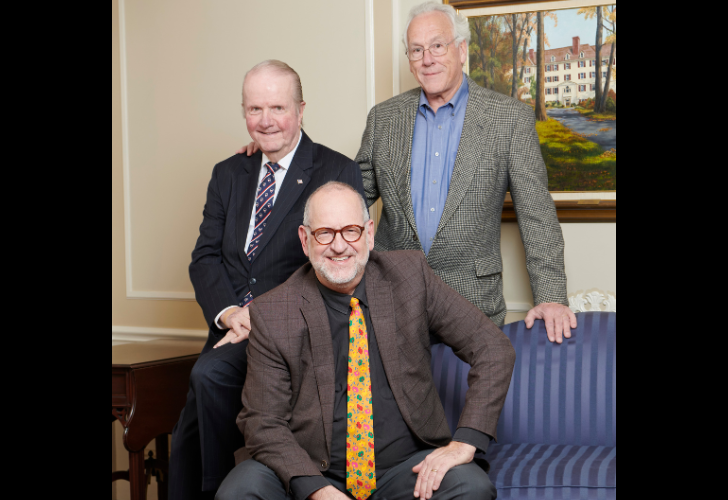
The board hired Collis Townsend, then just 31 years old, as the first executive director of the Delaware Community Foundation in 1987. He and the Board set about attracting the first funds and investments. “We had an all-star cast of Delaware philanthropists,” said Townsend. “My job was to be the glue, helping the community to build the foundation.”
In the earliest years, this meant winning charitable trusts from other institutions — bringing them to the DCF as “proof of concept” to attract new donors. Jeremiah Shea, then CEO of Bank of Delaware, endorsed the effort to consolidate 28 charitable trusts from Wilmington Trust and Bank of Delaware (today, PNC Bank) in 1987 and ‘88.
A series of major investments followed, most notably $2 million from the State of Delaware under Governor Mike Castle in 1989 and $500,000 from the Ford and John D. and Catherine T. McArthur Foundations in 1991.
By 1992, the DCF had raised $4.5 million to match the $2 million Founding Donors Campaign. Despite the DCF’s Wilmington headquarters, Townsend traveled up and down the state, telling donors and partners he “could make a breakfast meeting in Seaford.”
Another big move came from the creation of the Rodel Charitable Foundation Delaware as a supporting organization of the DCF in 1999 — the largest influx of assets to the DCF umbrella to that point. That year the DCF launched the Youth Philanthropy Boards, a still existing program that teaches high school students about charitable giving by giving them the means to do it.
Under Townsend, the DCF doubled its assets every three years.
Fred Sears – The DCF Hits Its Stride
After a year where Paul King served as president, Fred Sears came on as president and CEO in 2002. At the time, the DCF had a reputation among the philanthropic and business leaders of the state but was less well-known at a community level. Sears, former president of Commerce Bank Delaware, sought to build up a sales model to attract new donors. “We had to get out and be everywhere,” said Sears. “Every dinner, lunch—join the Rotary and Chambers of Commerce.”
That also meant opening a southern office in Georgetown, building upon the DCF’s commitment to serve all corners of the state.
Sears’ strategy paid off, and during his tenure the DCF partnered with some of its most well known fundholders, including the Delaware State Parks in 2002 and the Arsht family, which established the Arsht-Cannon Fund in 2003.
He also brought more nonprofits to the DCF. “We were really selling the concept that nonprofits needed endowment funds,” said Sears. “The DCF would be their money manager.”
Expanding on the success of the Youth Philanthropy Boards, in 2007 the DCF launched Next Gen North, a young professional group in New Castle County, with Next Gen South following five years later.
By 2014, the DCF had grown to $225 million in assets.
Stuart Comstock-Gay – In Perpetuity
Stuart Comstock-Gay joined the DCF as president and CEO in 2016. By then, many corporations had relocated their headquarters — and philanthropic leadership — outside Delaware. Donor advised funds from brokerage firms such as Schwab and Vanguard were becoming more popular, forcing community foundations to re-evaluate their role.
Over the next three years, the DCF under Comstock-Gay launched initiatives focused on improving quality of life for all Delawareans: Building Opportunity, a community lecture and book read started in 2018, and in 2019 Healthy Communities Delaware was launched in partnership with the University of Delaware and Delaware Department of Public Health.
Beginning in March 2020, Delawareans donated more than $5.3 million to the Delaware COVID-19 Strategic Response Fund, a partnership of the Delaware Community Foundation and Philanthropy Delaware. This was recognized as the fastest pandemic grantmaking response in the country.
“The program started as a quick way to get money to nonprofits to keep their doors open,” said Comstock-Gay. “As the community’s needs changed, the fund began awarding broader grants support to those isolated by the pandemic.”
When the recent Federal funding freeze threatened Delaware’s organizations, the DCF again answered the call: providing grants, seminars, and workshops to 100 nonprofits — with an estimated impact of $1 million and growing.
Today, the DCF holds $450 million in assets and is one of the largest philanthropic funders in the state and a top 100 community foundation nationwide. Its enduring role is a tribute to visionary, community-minded leaders whose charitable commitment continues to shape Delaware’s future, and it stands ready to secure philanthropy in the state now and forever.